Monday, December 19, 2022

Pizzelles: A Perfectionist's Perspective

Everyone gets on my case about being a perfectionist. And while it causes undue anxiety and tension in my life, there are times when it's helpful. And there are also times when others come out to play the game with me!

Pizzelle night is one of those moments.

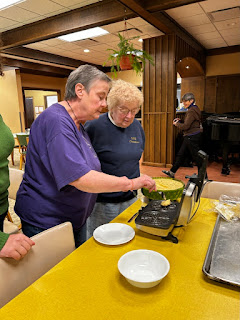
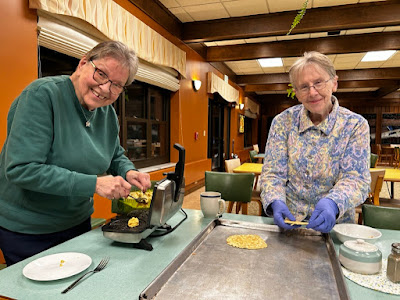
A yearly tradition at the monastery, everyone looks to make the *perfect* circle with the pizzelle irons, getting just the right amount of batter at just the right location for just the right amount of time. And when they do, they want everyone to know. And we all rejoice in those satisfying shapes.

Marilyn, responsible, for the operation, gives us all pointers before we start, elevating the hope that the perfect circle is within our reach!

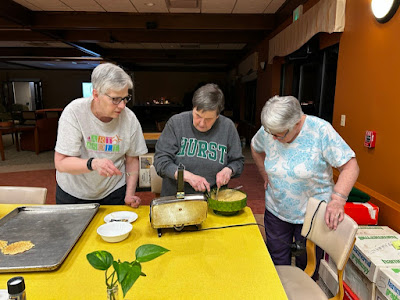
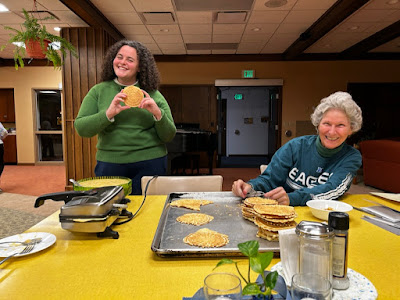
You can see many of my attempts above...Maybe not perfect, but they certainly offered an opportunity to appreciate diversity!

Many joined in on the fun!


Here was my best attempt of the evening!

But, of course, when they aren't perfect, we have to cut off the extra ends...and eat them, too! Maybe imperfections aren't so bad!

The anise and vanilla cookies are all boxed and ready to savor on Christmas Eve after Liturgy... Anticipation!

Let us walk in the holy presence.

Saturday, December 10, 2022

To Be of Use: More on Advent

One of my favorite scenes at the monastery these days can be spotted in our courtyard. Each Advent one of our sisters decorates with lights. It used to be just the magnolia tree, but now it has extended to the bushes on the west side of the courtyard. And this year, another extension! Look at Mary herself!


Salve Regina!

It makes me think of a Marge Piercy poem I love.

To be of use
Marge Piercy

The people I love the best
jump into work head first
without dallying in the shallows
and swim off with sure strokes almost out of sight.
They seem to become natives of that element,
the black sleek heads of seals
bouncing like half-submerged balls.

I love people who harness themselves, an ox to a heavy cart,
who pull like water buffalo, with massive patience,
who strain in the mud and the muck to move things forward,
who do what has to be done, again and again.

I want to be with people who submerge
in the task, who go into the fields to harvest
and work in a row and pass the bags along,
who are not parlor generals and field deserters
but move in a common rhythm
when the food must come in or the fire be put out.

The work of the world is common as mud.
Botched, it smears the hands, crumbles to dust.
But the thing worth doing well done
has a shape that satisfies, clean and evident.
Greek amphoras for wine or oil,
Hopi vases that held corn, are put in museums
but you know they were made to be used.
The pitcher cries for water to carry
and a person for work that is real.

Mary wants to be of use, too.

We know Mary isn't the passive young mother in the way history has portrayed her. No, she was fully submerged in the task of being the Mother of God, and she is a model for us today. She, too, is an incarnation of God's love in our world—teaching us mercy, compassion, resiliency, and courage. No wonder God opted for incarnation; we, too, are here to be put to use.

+++

My friend shared with me a most beautiful rendition of the first lines of Isaiah 54 from the group Sweet Honey in the Rock—Sing Oh Barren One. It's worth the 12 minutes, I promise!


+++

I just finished a book called lighter by yung pueblo. The cover has the appearance a self-help book, which can be off-putting to me, but I found it to be one of the most profound books that I've read about doing inner work, i.e. making it an appropriate and beautiful Advent read.

In between his prose, yung pueblo (It's a pseudonym meaning "young people" and signifying that "humanity is entering an era of remarkable growth and healing, when many will expand their self-awareness and release old burdens.") intersperses some short, thought-provoking poetry.

It's that inner work, or as monastics would call it—conversatio—that allows us to more fully express the truth of incarnation.

Here's an example of these poems, one which I think is also fitting for this liturgical season:

we allow ourselves to love because it's worth the risk
even though there is the chance of loss or hurt
we take the leap again and again
because love is one of the best parts of being alive
we don't do it because it's easy
we do it because connection makes everything brighter

Let us keep taking the risks of love—even when it doesn't feel useful, even when we feel barren.

Let us walk in the holy presence.

Saturday, December 3, 2022

Advent: A Different Perspective

On the first day that we heard Isaiah proclaimed at morning prayer our sister read with such conviction those dreamy, yet possible passages of hope, light, and promise. 

It must be Advent! And how good that is...

... because Advent offers us an opportunity to hope and dream of what it might look like if we took more seriously the reality of incarnation, the truth that we are embodied love.

It's a perspective we could really use these days. (Isn't that the kind of stuff we say each Advent?!)

I love this poem by Jan Richardson because it gives us a different perspective on the Annunciation. Of course we ponder for ourselves how insurmountable it might have felt for Mary to say "Yes" and hope we might muster up the courage to give a real, heartfelt one ourselves at least once in our lives.

But, how must it have felt to bear the news to Mary, to have to be the one to tell her about God's big ask? No wonder it took an angel!

I hope you love the poem, too.

Let us walk in the holy presence.


Gabriel’s Annunciation
Jan Richardson

For a moment
I hesitated
on the threshold.
For the space
of a breath
I paused,
unwilling to disturb
her last ordinary moment,
knowing that the next step
would cleave her life:
that this day
would slice her story
in two,
dividing all the days before
from all the ones
to come.

The artists would later
depict the scene:
Mary dazzled
by the archangel,
her head bowed
in humble assent,
awed by the messenger
who condescended
to leave paradise
to bestow such an honor
upon a woman, and mortal.

Yet I tell you
it was I who was dazzled,
I who found myself agape
when I came upon her—
reading, at the loom, in the kitchen,
I cannot now recall;
only that the woman before me—
blessed and full of grace
long before I called her so—
shimmered with how completely
she inhabited herself,
inhabited the space around her,
inhabited the moment
that hung between us.

I wanted to save her
from what I had been sent
to say.

Yet when the time came,
when I had stammered
the invitation
(history would not record
the sweat on my brow,
the pounding of my heart;
would not note
that I said
Do not be afraid
to myself as much as
to her)
it was she
who saved me—
her first deliverance—
her Let it be
not just declaration
to the Divine
but a word of solace,
of soothing,
of benediction

for the angel
in the doorway
who would hesitate
one last time—
just for the space
of a breath
torn from his chest—
before wrenching himself away
from her radiant consent,
her beautiful and
awful yes.

Wednesday, November 23, 2022

Renounce and Enjoy (and Give Thanks)

During her reflections at my final profession, our prioress quoted Gandhi's secret to life. (Get ready...it's not fun...)

Renounce and enjoy.

Isn't that brutal? Let go of it all, and experience joy. The gospel was about the young person who wanted to know the secret to inheriting eternal life. Renounce and enjoy... Really? Is there no other way?

Well, I got a fresh, and even more challenging, take on renunciation while reading Pema Chödrön's, The Wisdom of No Escape.

"Renunciation does not have to be regarded as negative. I was taught that it has to do with letting go of holding back. What one is renouncing is closing down and shutting off from life. You could say that renunciation is the same thing as opening to the teachings of the present moment.

"It's probably good to think of the ground of renunciation as being our good old selves, our basic decency and sense of humor. [...] It's as if everyone who has ever been born has the same birthright, which is enormous potential of warm heart and clear mind. The ground of renunciation is realizing that we already have exactly what we need, that what we have already is good. Every moment of time has enormous energy in it, and we could connect with that."

Renunciation is not just about giving up my possessions; it's about giving up anything that takes me out of the present moment. For me, that usually has something to do with giving up my ego and my anxieties and embracing my conceited, worried self just as it is. It means, after the awareness comes, trying to move away from the conceit and anxiety without beating myself up, but rather laughing at myself for falling into the traps of the ego, yet again, for the hundredth (thousandth?!) time that day. Renunciation is about giving up anything that takes me away from being who I am, where I am—so that I can be open, honest, and light-hearted about who I am, where I am.

Well, I'd rather renounce my extra winter coat.

(But it doesn't hurt to do that, too.)

I think, or at least hope, we've all had some taste of it—letting go of our agendas, letting go of our desire to live somewhere other than reality, letting go of our idea of the right way to do something, letting go of wanting to be something other than who we are—and tasting the joy that comes from just being. It's the call of meditation, as Pema would remind us. Let go. Breathe. Be. Renounce. Enjoy.

Yes, it's harder than giving away our coats, but there is indeed so much joy waiting for us there.

At the start of the chapter on renunciation from Pema, she writes that when people enter the Buddhist faith, they receive a title. People aren't too happy when they receive the title "Renunciation." No wonder.

We, too, in our community receive a title at profession. My title is "Of Mary, Joyful Bearer of the Word."

It's hard to joyfully bear much of anything when I am caught up in myself. No wonder I needed a reminder to "renounce" if I was going to "enjoy." 

I am so, so grateful to all those who journey on the path of renunciation with me. I am grateful to community, friends, family, guests of Emmaus, our volunteers, and so many more who come into my life with a reminder that the work of renunciation is worth it for the joy it bears in our lives.

Joyful Thanksgiving to you all!

Let us walk in the holy presence.


Saturday, November 12, 2022

War No More

I always struggle to decide if I should watch movies about war.

This choice is made even more difficult when my favorite trusty website, Rotten Tomatoes, shows a good rating for a film or show on the topic. (As my friends know, I trust the site's averages [sample size dependent] wholeheartedly.)

So, when I saw that the new film version of All Quiet on the Western Front had a 92% with 99 reviews, I had to do some discernment.

I did end up watching it. The opening scenes were mostly piles of dead, bloody bodies, and people stacking piles of dead, bloody bodies. That made me cry.

And now I am writing this blog in response.

+++

When I was teaching, I kept this classic poster somewhere in each of my classrooms.


+++

Here's a poem I love... Bees by Alden Solovy

The bees
Do not stop
Collecting pollen
When humans
Murder each other
With guns.
The bees think:
How strange,
How low
On the evolutionary scale
Must those humans be,
That they haven’t yet
Figured out
How to make honey
Or peace.

___________

When will those wildflowers in our backyard begin blooming?

+++

I taught in a Quaker school for a year, and we weren't even to put war into the curriculum. It's debatable on a lot of levels, but it's what we did. We also had a tribute assembly at that school when Pete Seeger died.


+++

Josh Ritter, one of my favorite artists, sings some of the best contemporary anti-war music I've found.


+++

Old Monk has a quote on the wall of her office...

"I dream of giving birth to a child who will ask: 'Mother, what was war?'"

Gets me every time.

+++

May we walk into the Advent season with the Peace of Christ in our hearts and in our voices.

+++

Let us walk in the holy presence.

Sunday, November 6, 2022

Another World

These are reflections I shared at Liturgy this morning, based on today's Lectionary.

II Maccabees 7:1-2, 9-14
Luke 20:27-38

_____________________________

You know, if I had chosen readings to reflect on, I wouldn’t have chosen these.

I might have chosen Mary and Martha, or the Prodigal Son, or, any number of other biblical stories.

BUT…

That’s what you get for saying “Yes” without looking at the readings first!

And, isn’t that how life is anyway? We wake up in the morning; we say “Yes” to a new day, and then… the experiences that present themselves are rarely the ones we’d choose for ourselves, or the ones we’d imagine having.

So often the life that comes our way is challenging, mysterious, unexpected.

But it’s our life, and we’ve chosen to say “Yes,” so we have to do something with it.

So we do our best to dive in, to grapple with it, to live.

And once we dive in and grapple with these readings, there’s much to glean about our attitudes, our choices, and our way of moving through the world.

“There is another world, but it is in this one.”

I read this quote in a book recommended to me about the possibility of creating utopias here and now.

In the story from the Maccabees, there is another world for rulers who scourge those who live by their convictions, and we experience it in the pained, yet strong mother and her faith-filled sons.

In Luke’s Gospel, there is another world for those so concerned about distinctions and black and white answers that they cannot fully live, and we experience it in burning bushes and resurrections.

But inhabiting that latter world involves a choice. And it’s a hard choice. Because we are anxious, because we want clarity and not complexity, because we aren’t willing to let go of our grasp on the way things “should be,” because the work, both inner and outer, required to live in that other world demands too much of us, and asks us to change in a way that feels too far a stretch for us.

Yet, still, we hear the call to that world each morning. And we have to choose daily, and even in each moment, which world we not only inhabit, but also create.

We know from our own experiences, and now from these Scripture stories, that it is our experience of the Divine that takes us into that other world; it is our experience with the suffering and those on the margins that takes us into that other world; it is our experience of hardships and the inherent messiness of being alive that open us up to that other world. Does the Divine scourge? Does the Divine want black and white?

We know another world is possible. We have experienced it—the one of the mother and her sons, the world where what we eat does not matter as much as making sure those around us are not starving while we ourselves feast. We can create it right now.

We know another world is possible. We have experienced it—the one where our belief in life eternal unites us, the world where our true marriage is to the oneness that connects us all. We can create it right now.

But, to live in that world, we also have to choose a different narrator. The narrator cannot be those in power; it cannot be the capitalist economy; it cannot be the oppressor. We have to hear another perspective.

Come to the soup kitchen and listen to any hungry guest. Go to the shoreline and watch the water rise inch by inch. Take a walk through the poverty of any town or city. Unite yourself with the pain of the world.

Let your world be turned upside down by this new perspective. Welcome it with an open and compassionate heart and a robust humility. Welcome it with a desire for change, a desire to create a new world.

Because there is another world, but it is in this one.

It’s why we come to this chapel, to be together and to strengthen our communal resolve to choose to live in and create that other world, here and now—the one we know is so available to us when we hear another perspective.

That’s the outer world—our relationships with each other and with the earth itself. And how about my inner world? What about my relationship with myself?

What happens when I choose to narrate my own story rather than let someone else do it? What other world emerges? The woman and her sons do not allow the ruler to narrate their story. Jesus does not allow the Sadducees to narrate his. And it’s not only that I narrate my own story, but it’s the attitude with which I narrate it. Do I narrate my story through the world of my jealousies, my grudges, my desire for control and easy answers? Or, do I narrate my life through my experience of the Divine? Is my story one of abundance, of gratitude, of concern for others?

The former is so much easier than the latter, so much more comfortable, so much more seemingly secure. But, we know the former world is passing away. As we move closer and closer to Advent, the choice becomes more and more clear and more and more necessary. Christ is coming. Let go of the world you knew. Say to yourself, “I am the light of the world. I am the light of the world. I am the light of the world.” Believe it. Become it.

The possibility of this Christ-centered world comes in each moment, and there is a deep call from God to choose it.

And its name is simple. It’s love.

_____________________________

Let us walk in the holy presence.


a new day begins at the monastery

Friday, October 28, 2022

On Community

This weekend is our annual community weekend. The formal one. Our sister Joan Chittister will be speaking on the Synod and synodality to the community, which includes many of our oblates who will join us beginning today. Some, coming from a greater distance, have already started trickling in, making for a nice, fuller choir at prayer this morning.

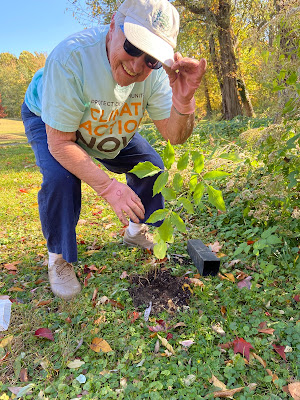
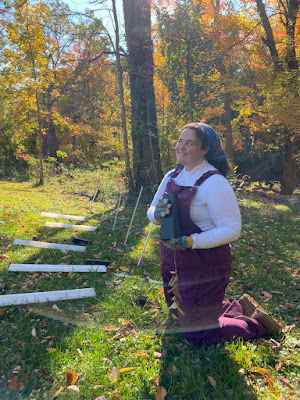
Last weekend was a different sort of "community weekend" as another 100 trees were planted across the street on our property at Glinodo. Many helping hands joined to plant the trees, mulch around them, and protect them from hungry deer with cages. Even our Sister Lucia, 89-years-old and still-going-strong (!!!), came out to help on a rather glorious fall day. The trees were planted as part of the Re-Leaf project from LEAF (Lake Erie Arboretum at Frontier), with a goal to plant one tree for each citizen in the county over the course of a few years. They serve a double purpose, though. The trees will grow where the goats (who were here in the summer) gobbled up invasive species. This helps to prevent as much re-growth of the multiflora roses and other varieties that had taken over by the creek. Native berry trees made up the majority of one hundred planted.

Planting along the creek

Thanks, Lucia!

Jackie looking like she belongs on a holy card!

Jackie liked that I was wearing an appropriate shirt; it reads, "Cultivate community"

Certainly these trees and their roots will strengthen each other as they add more beauty to our property.

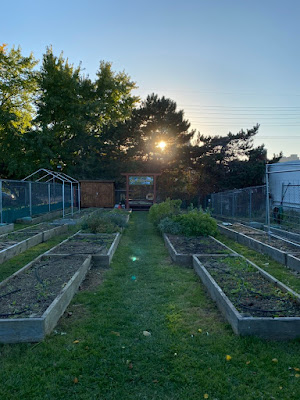
The Thursday before Saturday, eighth graders from St. Luke's parish school came to Emmaus Grove to clear the garden for the winter, providing a great help to our master gardeners who volunteer their time to plant and harvest over 2,000 pounds of fresh produce each season for guests at our food pantry.


We know that caring for the earth is a communal effort, so it's wonderful to watch so many people coming out to help with these good projects.

And fall is definitely here, so the work must get done sooner rather than later! It’s hard for me to let go of the warmth and fullness of late summer. You know those days when you might need a sweatshirt but can still get away with shorts if you really want to? As I scraped my car this morning for the first time, I knew summer had really ended.

Fall is here.
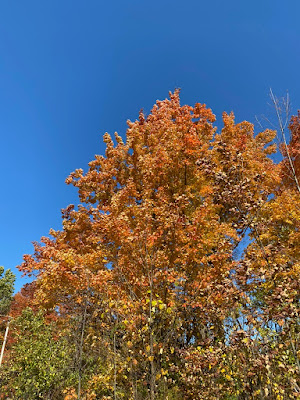
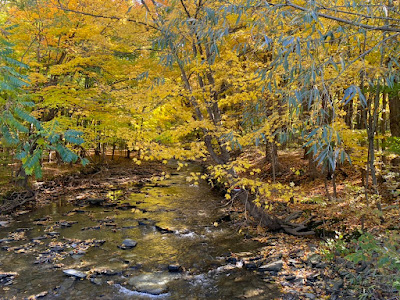
But, goodness, isn't it beautiful?

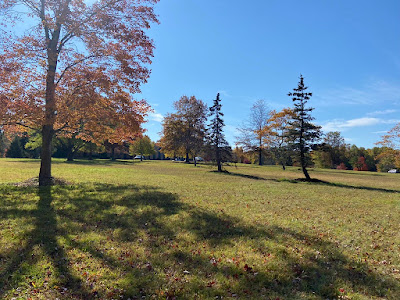
Natural proof that blue and orange belong together!


One of Jackie's goddaughters snapped this photo...I am obsessed with the shadows.

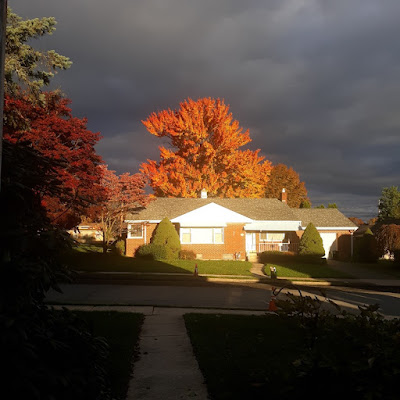
Mom snapped this one and sent it to me! She said it never stormed though...

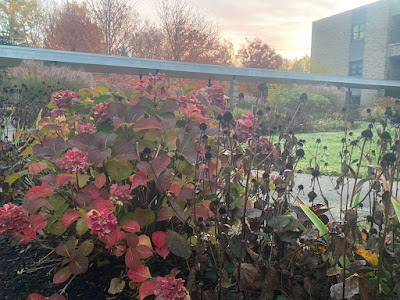
I love the vibrant, richly colored hydrangeas next to the bare black-eyed susans... talk about diversity in community!

I thought our "library tree" couldn't get any more beautiful than it does during its spring blossoming, but this red hue might be close!


The letting go and trusting that the fall season calls us to are much more bearable when we are surrounded by community...by each other and by the beauty of nature.

Let us walk in the holy presence.

Pax in Terra: A Meditation from Pema Chödrön

" One of the astronauts who went to the moon later described his experience looking back at Earth from that perspective. Earth looked s...